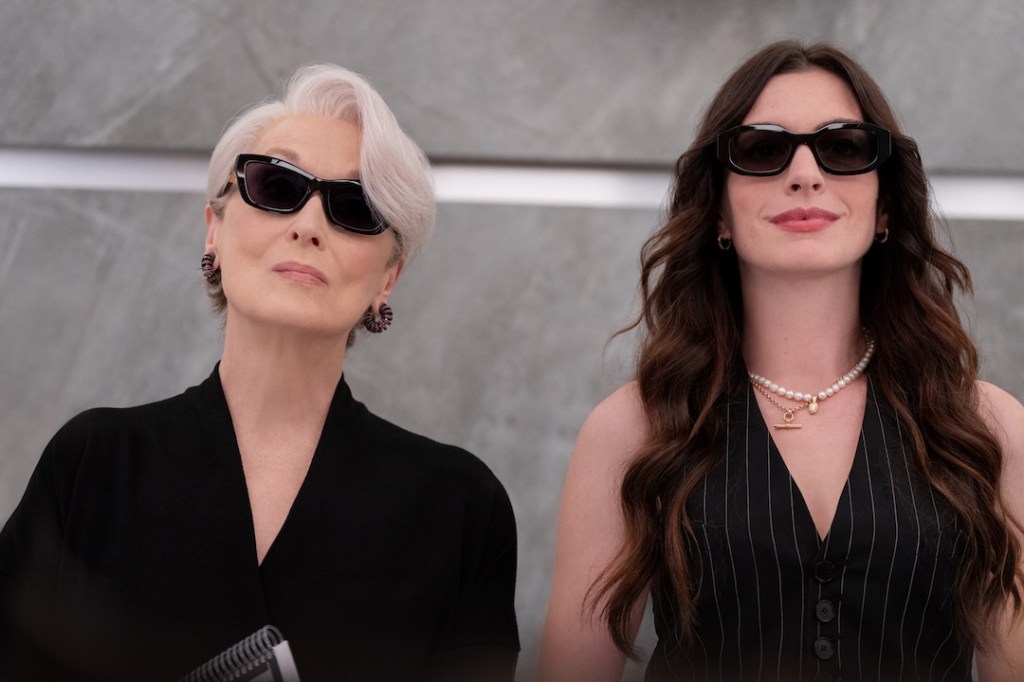
Meryl Streep, Anne Hathaway, Emily Blunt and Stanley Tucci return, joined by
The film begins with a close-up shot of a bathroom mirror wipe; its last line of dialogue is “Go!”
Both are close duplicates of how The Devil Wears Prada began and concluded in 2006, and are emblematic of the fanservice that the film’s creators are intent on including in the film’s sequel. So many Easter eggs are featured that it sometimes feels that they are the sequel’s sole purpose.
But then there’s Meryl Streep.
Twenty years ago, Miranda Priestly (Meryl Streep), all-powerful editor of revered high-fashion magazine Runway, cannily averted a takeover bid by steering her rival toward a new fashion company co-leadership role that had been promised to her creative director, Nigel (Stanley Tucci). Shocked back to reality by Miranda’s cold calculation, her personal assistant #1 Andy Sachs (Anne Hathaway) saved her soul from the Devil — see title — by quitting her job and applying at a New York newspaper to begin a proper career as a journalist. This allowed Miranda’s personal assistant #2 Emily (Emily Blunt) to resume her role as personal assistant #1; she lost the #1 position when Andy made herself invaluable with her incredible work ethic and impeccable health.
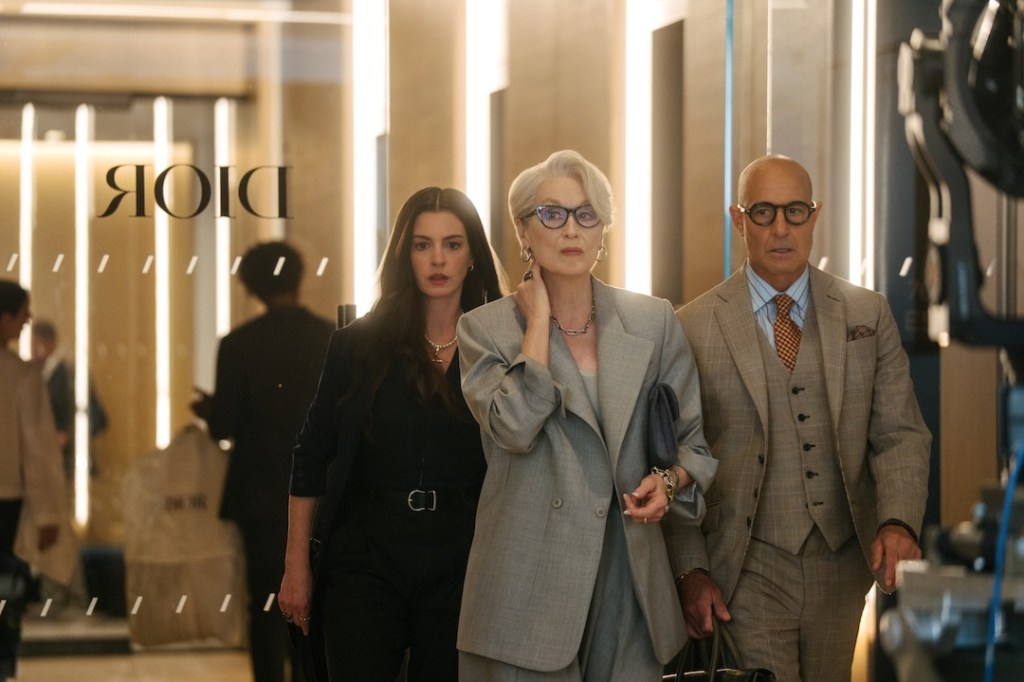
The sequel begins with Andy accepting a journalism award for her work as an investigative reporter at a New York publication, while simultaneously learning that she and her fellow journalists have all been laid off. As it happens, Miranda just came under fire for accusations of showing favor to a sweatshop operation. So Miranda’s publisher Irv Ravitz (Tibor Feldman) offers Andy a job as features editor at Runway with the mandate to clean up Miranda’s reputation and keep advertisers from jumping ship.
Once Andy arrives at the Runway offices, she learns that Miranda had no idea about her boss’ decision, and, furthermore, evinces no recollection that Andy ever worked for her. (To be fair, it has been 20 years, and Andy worked there for less than 12 months.) Tossed into the fire, Andy must drive up readership numbers and, perhaps, reestablish a friendly relationship with her former boss.
First published in 2003, Lauren Weisburger’s bestselling novel The Devil Wears Prada was widely considered to be a roman à clef because Weisburger formerly served as a personal assistant to Anna Wintour, the all-powerful editor of revered high-fashion magazine Vogue. The story changed a bit in its translation to the big screen, as adapted by Aline Brosh McKenna (know for scripting various rom-coms), but featured a buoyant spirit, a fresh, insider-style look at the fashion world that was still sometimes skeptical, and an irresistibly imperious Meryl Streep.
Author Weisburger has written two sequels to her novel, but neither Revenge Wears Prada: The Devil Returns, first published in 2013, nor When Life Gives You Lululemons, first published in 2018, furnished any source material for The Devil Wears Prada 2, again scripted by Aline Brosh McKenna and directed by David Frankel, a journeyman filmmaker who helmed episodes of Sex and the City before making the original Devil.
Carefully engineered as it is to provoke fond memories, the sequel struggles to find sufficient oxygen to breathe new life into the premise. Miranda Priestly has been diminished by societal changes in the past 20 years; she must watch her language in meetings with her staff, lest she inadvertently offend someone with her choice of insults, and must even hang up her own coat — not dump it and her purse on the desk of her hapless personal assistant #2. (Oh, the horror!)
With 20 years under her belt, Andy is a seasoned journalist, not the recent college graduate desperate for Miranda’s approval. Yet she now finds herself in the position of having to prove herself again in a social media world of clickbait, which frustrates her endlessly. (Tell me about it.)
Miranda still has stoic Nigel around to underappreciate, and, though her twin daughters are grown and out of the house, she has a new partner (Kenneth Branagh), a musician who is quite content to be underappreciated. Yet Miranda still finds herself having to prove her worth to cautious advertisers, represented as a class by Emily, who now works at Dior, while holding a grudge against Miranda.
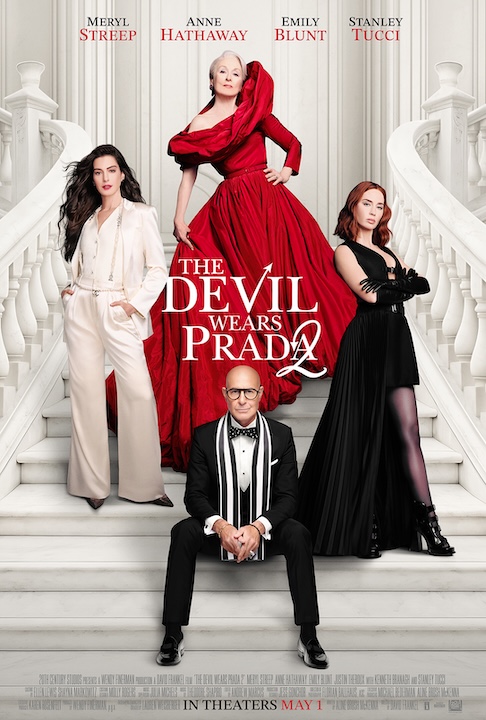
The sequel’s obligatory diligence to pay respect to current workplace standards and its outdated view of online journalism, which already feels moldy, contributes to a weary, dreary feeling that lacks the driving energy that animated the first film. Bringing in Lucy Liu, Justin Theroux, and B.J. Novak for glorified cameos as three types of obscenely wealthy people — the good, the bad, and the ugly, not in that order — keep the narrative moving in an orderly fashion.
What saves the film from complete mediocrity is Meryl Streep’s performance. Her character feels more constricted by all the changes that culture changes have foisted upon her; she constantly wonders whether her time has passed. Even if she doesn’t say so out loud, her body language and her facial expressions convey her resignation and a sense of despair. (See the frustration of her body language in having to hang up her own coat, her embarrassment at having to eat in the company cafeteria, and the way she flinches whenever her new boss touches her.)
It’s a jewel of a performance, which justifies the film’s existence, all on its own.
The film opens Friday, May 1, only in movie theaters. For locations and showtimes, visit Fandango.