15. The Outrun
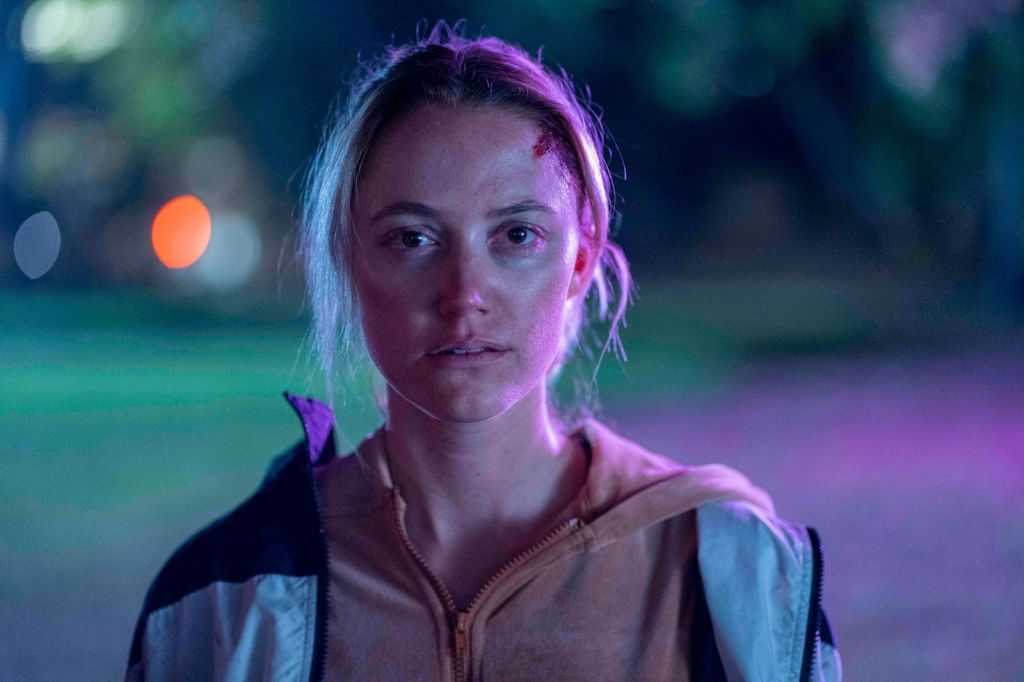
Saiorse Ronan gives a tremendous performance as a young woman struggling to stay sober fresh out of rehab. I guess an easy way to do so is to isolate oneself on a windy, desolate Scottish island and study birds. Nora Fingscheidt’s film (based on the memoir by co-writer Amy Liptrot) jumbles up the narrative timeline, and typically, this type of formal diversion confuses or negates some of the emotion, but The Outrun gains in feeling as the film pushes and breaks apart time. It’s an exercise that places us in the splintered, warp-speed mind of the young woman fighting the urges of her own addiction and crafts a moving testament to the power of getting better.
14. Longlegs
Even despite Nicolas Cage being delirious Nicolas Cage, Osgood Perkins’ serial killer thriller succeeds due to its razor-sharp attitude of doom-laden atmosphere. I saw this film twice, and it’s a film whose attributes really shine once one knows what to expect (especially in Maika Monroe’s somnambulant performance). Several scenes gave me straight up chills, and for a film so indebted to the often wasteful trauma horror that’s overtaken the genre nowadays, Longlegs crawls out of the ordinary and earns its very heavy allusions to psychological control and dangerous gaslighting child development.
13. Without Arrows
Elizabeth Day and Jonathan Olshefski Without Arrows follows the Fiddler family for over a decade as they simply exist on a South Dakota Indian reservation. Entertaining, heartbreaking, and a meditative examination on the small miracles of what it means to be a Native American family in the United States today, Without Arrows manages to show us sorrow, joy, hard truths, and survival as people pass on, children play, and the Fiddler family sets up tents for big family dinners. It’s full of the little moments as well as the big ones and reveals a family in rich flux. I mean, honestly, who ever imagined the hard process of getting a buffalo head and fur into the trunk of a Mazda? As this wonderful documentary ended, I felt as if I’d lived within an ecosystem of plains life never quite witnessed before.
12. The Remarkable Life of Ibelin
I never played World of Warcraft, but as someone who grew up alongside the burgeoning Internet, the idea of a faceless community turning into a curated online family is something I certainly experienced. Hours of my teenage life were spent making friends through various chat rooms and online message boards where the words (and subtle meanings expressed behind them) generated pathos and appreciation for people I never, and would never, actually meet. But the sense of fraternity was always present. Benjamin Ree’s The Remarkable Life of Ibelin is the best film to ever document what it felt like to be a part of a very small corner of that dot-and-blip universe. Following the short life of a young disabled man and his immersion into the computer gaming world before his death, the documentary then takes an affirmative turn when his parents send an innocent message out across the web. What comes back to them is recreated in animated form as the film shows just exactly how valuable and powerful even the smallest interactions can be….. whether it’s in the real or the virtual world.
11. The Order
Based on the real-life case of an FBI agent’s cat-and-mouse investigation into the crimes of a white supremacist organization who’ve split from a larger community, Justin Kurzel’s The Order is lean, grizzled, and bolstered by strong performances. Kurzel has always been fascinated with true crime stories (see his Snowtown and Nitram), but The Order is his most accomplished and clear-eyed exploration yet, complete with robbery shoot-outs and a barn-burning finale that understands the tension of logistics. Granted, Jude Law (as the agent obsessed with the policeman bringing along fresh eyed Tye Sheridan) isn’t a largely complex character, but The Order succeeds because it feels like something ripped out of the no-nonsense 1970’s where back story is just a marginal reason for guilt and the real complexity lies in the compulsive need to maintain law in an orderless wild west. I doubt this film will be in theaters long, so seek it out when you can.
10. The Breaking Ice
Nana (Zhou Dongyu) is a tour guide permanently estranged from her family, constantly dreaming about her previous life as a figure skater before an accident injured her body. Hao Feng (Liu Haoran) is a tourist in town for a wedding who seems to be enamored with dangling his body on the edges of tall places and almost daring himself to jump. Han Xiao (Qu Chuxiao) is a friend of Nana, barely living as a delivery boy for his family’s restaurant that serves most of the tourists. With beguiling ease, this trio become friends (and partly lovers) over the course of a few days, dancing in strobe-lit techno clubs and flirting with the cold exterior of their Yangi province. Directed by Anthony Chen with masterful attention to the tender vagaries of these people all suffering with some unspoken trauma, The Breaking Ice thankfully eschews the menage-a-trois popularity of recent dramas and mines its own path of quiet sadness and unspoken connection. There are touching moments here that would feel cheapened by the lurid appeal of simply switching partners, and Chen’s narrative makes clear that each character needs to find their own way out of the (literal) wilderness and piece back together something. Like the title, these are twenty-somethings just trying to manage not to fall into the abyss. A sweeping soundtrack, snatches of images that are brilliantly composed (just watch the skating park scene as Nana watches on), and a bittersweet finale all create one of the year’s most underappreciated efforts.
9. Omar and Cedric: If This Ever Gets Weird
I didn’t think it was possible to appreciate the creativity of Omar and Cedric from At the Drive-In and The Mars Volta any more than I already did, but this film kicks my love up even higher. Avant-garde VHS images, profane ramblings, and snatches of their music coalesce into a trippy, emotional exploration of their relationship. Seeing this on the big screen, with loud… very loud Dolby speakers created an out-of-body experience.
8. The Sweet East
From its opening few minutes when teenager Lillian (a vibrant Talia Ryder) sings a song into a streaky restroom mirror and then erupts on an “Alice In Wonderland”-like vaunt across a funky, ideologically dangerous swath of the Northeast, Sean Price Williams’ The Sweet East had me hooked. From that jumping off point, the film follows Lillian through about seven different genres as she leaves her old life behind and becomes the ethereal memento for a wide variety of denizens of an ever-shifting environment- from activist punks to shady White Nationalist incels to a fast-talking filmmaking duo who solicit her for their movie, The Sweet East is erratic, jagged, and at times exhausting. But it’s also extravagantly beautiful and bursting with nervous life and a central performance by Ryder that stands as one of the most beguiling of the year. She not only holds the center of an effort that has her in the clutches of so many divergent characters, but she remains wholly believable. And separating itself from the pitfalls of mumblecore presentations and low-budget teen gazing (like the recent Ross Brothers film Gasoline Rainbow), The Sweet East actually has something to say about the pungent state of America today. The fact that Ryder and filmmaker Williams end on a slight barrier-breaking smile and glance at the camera, the film also comments that, perhaps, the kids might be okay.
7. Touch
Unabashed in its old-fashioned pangs of longing and seductively edited in its time shifting narrative of lost love years ago and the search to find it again in the golden twilight of life, Touch is a sentimental and moving effort by the varied Baltasar Kormakur. I’m a sucker for this type of lush, novelistic storytelling (see anything by the greatly underrated Julio Medem as well) and Touch gets it right. Facing the end of his life, Kristofer (Egil Olaffson) goes in search of his now lost first love, Miko. Alternating between his modern-day search and their developing relationship as teenagers in London during the late 60’s, Touch doesn’t hold back its melodramatic yearnings, and it’s a magical film for not doing so.
6. Love Lies Bleeding
Like she did with her previous film Saint Maud, filmmaker Rose Glass thwarts genre expectation and mixes everything up into one feverish exploration of love, lust, self-delusion, and violence. Taking its main themes from hardboiled neo-noir and tinged at the edges with straight up horror film declarations, I had an immense blast with whatever genre Glass chooses to throw at us in Love Lies Bleeding. As the couple at the center of its bloody tit-for-tat revenge drama, Kristen Stewart and newcomer Katy O’Brian are electric, but it’s the film’s pace, editing and ultimate holler of a finale that sets Love Lies Bleeding apart. By the time we follow Jackie (O’Brian) to her bodybuilding showcase in Las Vegas, the film reaches a simmering point of magnificent nervousness that’s been bubbling just beneath the surface for some time, and from that moment on, Glass and crew elevate the film into a crescendo of mythical affection and shattering violence. Grand swings and grand hits.
5. His Three Daughters
In addition to its three great awards-worthy performances from Carrie Coon, Nathasha Lyonne, and Elizabeth Olsen, Azazel Jacobs’ His Three Daughters excels in subtle visual intelligence. Mostly confined to a New York apartment where the three sisters are caring for their dying father, tensions run high as the three struggle to find a harmonious balance of the generations. Jacobs rarely films them together, instead choosing to compartmentalize their wonderful monologues and dialogue as if they’re natural extensions of the walls and barriers around them. It all makes for a moving contradiction of visual acuity that opens up the wordiness and staginess of the affair. But aesthetics aside, His Three Daughters is also a magnificently timed exploration of grief that hits like a ton of bricks as memory and eventual absence descends. Jacobs has made some essential films over the years, but none quite as mature or piercing as this.
4. Evil Does Not Exist
Ryusuke Hamaguchi’s Evil Does Not Exist is a tantalizing, challenging wonder. Part eco-thriller, but mostly a deliberate drama about the entrenching scale of urban growth into peaceful forestry, Hamaguchi employs his distinctive observational style to subtly shift gears between both. Imagine if Frederick Wiseman were present in this peaceful, natural village to film a board meeting about the possibilities of tourism advancement versus the quiet disdain of its townsfolk. For about twenty minutes, this is what we get, and (like Wiseman’s films) it’s an utterly mesmerizing act of ebb and flow emotion as the villagers raise their concerns, and the two Japanese mouthpieces deflect their concerns. It also features a jaw-dropping finale that opens up the entire film even more as a complex imagining of the metaphysical world around us.
3. Furiosa: A Mad Max Saga
Should have been the blockbuster of the year. But that’s okay. I liked Fury Road. Furiosa is a masterpiece. It’s a film that deepens, strengthens, and expands on filmmaker George Miller’s imaginatively conceived brutal wasteland of post apocalypse Australia. Stretching back to the early 80’s, Miller’s violent brushstrokes have always generated cathartic thrills, but here the focus on certain people within the barren landscape have added a real gravitas to the barbaric modes of survival, and with Anya Taylor Joy (and to a large degree the young performance of Alyla Browne who gives an equally wordless, soulful performance), Miller’s franchise has found a worthy beating heart of revenge that was built up in Fury Road and now given vengeful dimensions here. Pretty much breathtaking from its opening scene, Furiosa is also a masterclass in how to film action sequences. Crisp, fluid, and edited to a propulsive sense of rhythm that is lost in most big budget action spectacles, Furiosa also wins in its maximalism.
2. The Brutalist
Brady Corbet’s mammoth film has lingered in my memory more than any other film this year. Uncompromising both in visual scope and character, it’s a film whose corrosive portrait of the individual crushed by the insular ways of big money and big attitudes in a country that advertises freedom, but only gives it in sparse, controlling ways, moves in beguiling ways. Through its 3-and-a-half-hour run-time, I was enthralled, confused, enraptured…. then ultimately bowled over by a film whose immigrant experience is probably the closest to how it actually was- a New Land that doled out triumph and tragedy in equal measures.
1. Anora
For all its anxiety inducing set pieces, the most masterful thing about Sean Baker’s electric Anora is that all the controlled chaos only makes the quiet, reflective moments that much more powerful. As the title character, Mikey Madison gives a ferociously alive portrayal of a woman caught up in a spiral of very messed-up hide and seek when her newlywed Russian husband goes missing, and his very powerful family’s goons push her along in their sweaty, nocturnal search. Perched between desperate vulnerability and hilarious, Three Stooges-like humor, Anora throttles along with the speed and emotional ingenuity that’s been brewing in Baker’s oeuvre for a long time now. Whether it’s the wind-swept beauty of bodies hustling alongside Coney Island or the half-observed face of Madison as she slinks down in the front seat of an SUV and cries, Anora is Baker’s masterpiece that captures the ragged beauty of both the interior and exterior.
Honorable mentions: A Complete Unknown, Will &Harper, Girl Internet Show A Kati Kelli Mixtape, Red Rooms, Print It Black, Porcelain War, Origin
 Dallas Film Now.