
The 18th incarnation of the Dallas International Film Festival cranked up Thursday night, and while I chose to skip the opening night premiere of Dude Perfect: A Very Long Shot (which apparently played to a throng of people and fans alike), it’s always comforting to settle into a slate of films on the second day of the festival where the hype is a bit subdued and people can congregate in the lobby and just talk about films. Which is exactly what I did.
Abby Ginzberg and Christy Carpenter’s Shaking It Up: The Life and Times of Liz Carpenter, a documentary about the political firebrand of Mrs. Carpenter, feels tailor made for a film festival in Texas. We love to celebrate people and place them right at home in the pantheon of tough-skinned-unfiltered-tongued wisecrackers that have dotted our political landscape for decades. And Liz Carpenter certainly qualifies as this. Also fortunate is that many of her tough-skinned peers are also on hand to talk about their experiences with Carpenter as she worked her way from humble newswoman in the Austin and Houston in the 40’s and 50’s to her ascension as one of the most important conduits of the Lyndon Johnson White House.
Coming from five generations of Texan history and (by her own admission) meeting or working with twelve United States presidents in her political travails, Shaking It Up: The Life and Times of Liz Carpenter doesn’t break any new ground in the documentary format. However, when one has access to the trove of footage and interviews available, the fascinating subject matter speaks for itself. And although the film probably goes a little too soft on the Johnson administration’s Vietnam years, the most important thing it does amplify is a time in governmental decision making that’s not a “bloodsport”, but one that seeks to elevate the people it represents. In this day and age, that’s something that feels completely foreign and I wonder how Liz Carpenter would handle things.
___________________________________________________________________________
Well, slow cinema has finally come for even the horror genre. Chris Nash’s In a Violent Nature is totally in love with the steadicam shot as it follows a slasher killer rising from his grave and methodically hunting down anyone who might have stolen from his grave. It lingers on the objects the killer picks up along the way. It frames (often in long shot) the muddy, knotty wilderness he treks through. And it observes several of his gnarly kills as if Bela Tarr were at the helm.
In a Violent Nature is more parody than horror film deconstruction, toying with our expectations and using the genre to highlight our recognized hallmarks from a starkly different point of view. As evidenced by a scene in a lake (Friday the 13th anyone?) where two young girls flirt with one another followed by “I’m going to stretch out. And then you can come and stretch me out….”, the film clearly idolizes the horror genre and wants to pay homage while attempting something a bit different.
But beyond that and once it’s one-note construction becomes thuddingly obvious, the film doesn’t really exceed anything beyond the rote slasher film it’s trying to obliterate. What I found the most exhilarating, however, is a finale that dares to slow down the hunter-killer mantra to a crawl and just let the tension of two people talking in a car become the sole focus. My mind flashed back to The Texas Chainsaw Massacre (1973) and its dirt road truck getaway (surely Nash’s intention), and this is where In a Violent Nature finally breaks free from its slasher monotony and reaches something truly original. It does a terrific job of sustained tension here, something sorely lacking for the previous 80 minutes once the novelty wears off.
___________________________________________________________________________
Written and directed by Anu Valia, We Strangers also plays with expectations, but this time the genre is much more subdued than a horror film. Although I suppose it could be classified as psychological horror.
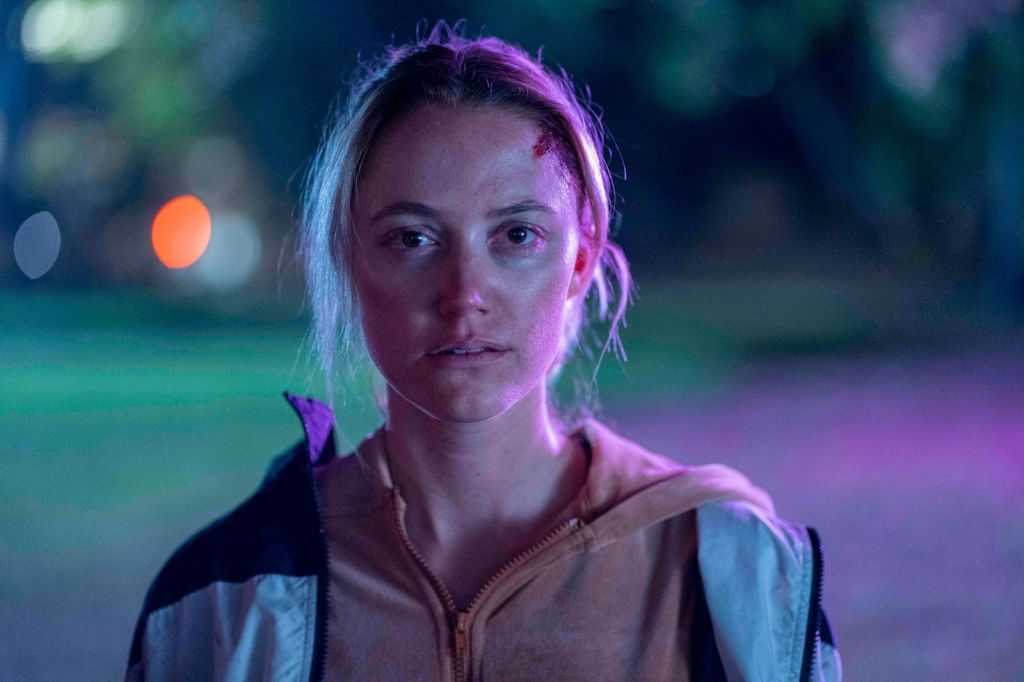
Starting a job with a new client, Ray (played by an actress Kirby), begins cleaning house for a wealthy doctor (Hari Dhillon) and steps right into a low-key struggle of class divide and manipulation. The doctor’s wife (Sarah Goldberg) is obviously unhappy. The husband may be having an affair with their neighbor (Maria Dizzia,) and their daughter (Mischa Reddy) is on the verge of becoming a full-fledged kleptomaniac.
Seeing right through all of this social malaise (and being nothing like the daily struggles Ray endures), Ray decides to take advantage of their strife, and We Strangers subtly ambles through the ways she decides to manipulate and acclimate herself in their upper class lifestyle.
Assured in framing, editing, and score (featuring one slinky solo dance by Kirby that ranks as one of the most alluring scenes of the year). filmmaker Valia is in firm control of technique. However, all of these technical aspects are in lieu of a disposable story that comes across as underwhelming. Allusions to the 1902 eruption of Mount Pele and several scenes that drastically break up the tempo of the film are ill-fitted, especially when it comes to Ray’s homelife. The echoes of Michael Haneke-lite are there, but We Strangers ultimately failed to strike a chord with me.
The 2024 Dallas International Film Festival runs through May 2nd. Schedule and tickets can be found at dallasfilm.org/diff
 Dallas Film Now.