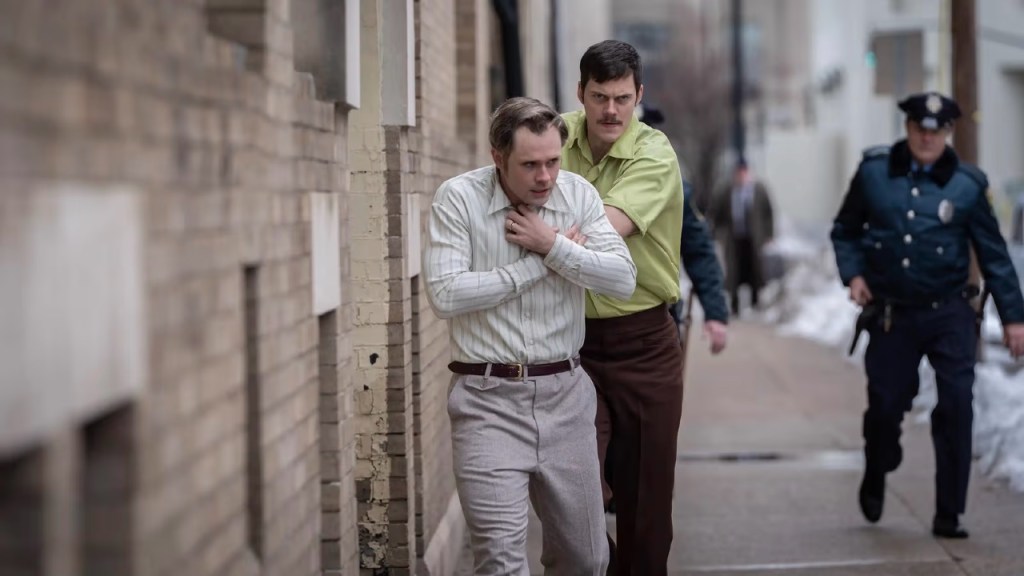
Bill Skarsgard, Dacre Montgomery, Cary Elwes, Myha’la, Colman Domingo, and Al Pacino star in Gus Van Sant’s latest, based on a true story.
Striding into frame, the contained fury of Tony Kiritsis (Bill Skarsgard) is enough to unsettle anyone.
For the folks at Meridian Mortgage Company in Indianapolis, Indiana, it’s just another day, February 8, 1977, to be exact, and Tony Kiritsis is a familiar face. They are accustomed to seeing the scowl atop his lean, tall frame, and don’t take much notice of the large package he carries under his arm.
The mortgage company’s owner, M.L. Hall, is away that day, and so his son Richard Hall (Dacre Montgomery), keeps the appointment that Tony made with his father to discuss some continuing business about a property that Tony purchased. Instead, Tony pulls out a handgun and unwraps the package he was carrying, revealing a shotgun affixed to a wire that he proceeds to strap around the hapless Richard’s neck.
Charging out of the office and onto the street, Tony pulls Richard with him, promising that the shotgun will blast his head off if Richard jiggers with it at all or doesn’t keep the necessary tension in the affixed wire. The sight stops or bewilders bystanders, as well as arriving police officers, including Michael Grable (Cary Elwes), who knows Tony as a fellow patron of the local cop bar.
Soon, Tony and Richard are sequestered in Tony’s apartment, where Richard must endure hours and hours of Tony talking at him and shouting at cops outside, which are all set up, but keep from shooting or storming the building because of the shotgun contraption that Tony has rigged up on poor Richard.
Based on a true story — still photographs are displayed and/or recreated, periodically, throughout the film, and it concludes with excerpts from archival television news footage — Dead Man’s Wire reminds especially of Sidney Lumet’s Dog Day Afternoon, not only because it depicted a real-life, extended incident involving inexperienced criminals, but because of Al Pacino’s supporting role as the self-satisfied M.L. Hall, who regrets to inform the outraged Tony that he absolutely refuses to apologize for any of his actions, even if it prompts Tony to kill his son: “Stay strong, son! See ya later!” he concludes a telephone conversation from his timely vacation perch in Florida.

Even though it’s a tense situation, the script by first-time feature writer Austin Kolodney is sufficiently confident to cut away to local radio DJ Fred Temple (Colman Domingo) and local TV reporter Linda Page (Myha’la) as she endeavors to get more air time with dogged determination. In essence, Dead Man’s Wire is on the side of the strivers, such as Linda, as well as those who wisely don’t want to do anything to get Tony upset but understand where he’s coming from, like police detective Michael Grable and smooth-talking DJ Fred Temple.
To a certain extent, the movie feels Tony’s pain. It’s not completely indifferent to the extended pains of poor Richard, but it knows what it’s like to continually seek satisfaction for wrongs that have befallen you by those in positions of power.
In this, it’s a bit different from Gus Van Sant’s past films inspired by true events, such as To Die For (1995), Elephant (2003), and Milk (2008), which each took different approaches to their source material. With Dead Man’s Wire, the director acknowledges that the very desperate Tony Kiritsis was justified in using outrageous means to achieve something that was, apparently, always out of reach: a simple and true apology from a rich person who had done him wrong.
The rich are different from you and me: they never say they’re sorry.
The film is now playing in select area theaters and will expand wider on Friday, January 16. For more information about the film, visit the official site.


 Dallas Film Now.