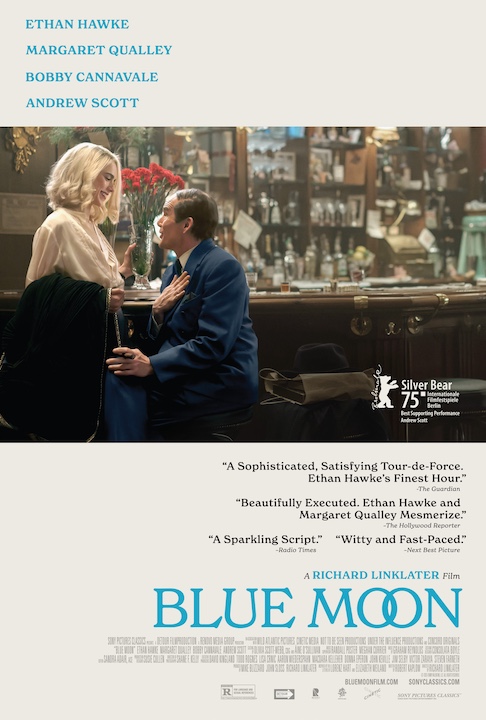
In Richard Linklater’s lovely film, Ethan Hawke stars as lyricist Lorenz Hart, supported by Margaret Qualley, Bobby Canavale, and Andrew Scott.
Overflowing with poignance, Blue Moon unfolds in 1943, when Oklahoma!, a new musical by composer Richard Rodgers (Andew Scott) and lyricist Oscar Hammerstein II (Simon Delaney), opened on Broadway to a rapturous reception.
The show also marked the first show in 24 years that Rodgers did not write with lyricist Lorenz Hart (Ethan Hawke). The opening night of Oklahoma! marked the conclusion of one partnership and the beginning of another. Just seven months later, lyricist Hart collapsed in a drunken stupor, alone on a rainy night in Manhattan. He died four days later.
Bookended by those facts, Richard Linklater’s Blue Moon can’t help but make one feel, well, blue. Suffused by melancholy as it is, then, it’s a wonder that the film instead is quite sprightly as it plays, much of that driven by Ethan Hawke’s portrayal of a man in transition, who has yet to decide which way he wants to turn.
Having sneaked early out of the theater before it ends — Hart had already seen it in previews, and clearly couldn’t take any more of Hammerstein’s predictable lyrics — Hart heads to Sardi’s, where he knows he is always welcome, no matter the “Closed” sign on the door. The staff at Sardi’s all know him and are accustomed to his ways, most notably the bartender (Bobby Canavale) and the piano player, who gently banter with Hart, even when they don’t agree with and/or fully understand his clever, cutting jibes.
Hart is waiting for the arrival of his so-called protege (Margaret Qualley), a 20-year-old college student with whom he is besotted, no matter the young man with whom she is besotted. Hart is also anticipating the arrival of his longtime partner Richard Rodgers, though the air is fraught with tension, since the viewer doesn’t know, exactly, what caused the disruption to their partnership.
Early on, the bartender gives clues that Larry, as most everyone calls Lorenz Hart, is a confirmed alcoholic, but he still has a fondness for the alcohol that we already know will contribute to his death just a few months later. With that hanging over Larry like the sword of Damocles, Larry chats a mile a minute about nothing and everything.
Eventually, he notices E.B. White (Patrick Kennedy) sitting at a table in the otherwise empty bar, scribbling away on a notebook. Naturally, Larry is a great admirer of The New Yorker essayist — and later children’s book author of Stuart Little and Charlotte’s Web — and engages in more witty banter with White.
Written by Robert Kaplow, inspired by letters by Hart, Blue Moon flows by like a steadily-flowing river. Though the film takes place almost entirely on the downstairs floor at Sardi’s, director Richard Linklater composes each shot differently. Captured with precision and fabulous lighting by cinematographer Shane F. Kelly — Margaret Qualley looks especially luminous — and edited by Sandra Adair like the flapping of a hummingbird’s wings, Blue Moon is lyrical and poetic, an incessant barrage of words that never feel forced, just extremely fluent, and modulated to the tune of everyday language.
Hawke is the obvious standout, of course, softly nailing his portrayal of a doomed man who didn’t know he was doomed, and never wishes to give up hope that his fondest wishes might one day come true, even in the face of impossible odds and kind denials of those possibilities. Margaret Qualley looks quite stunning, while exuding the beauty of youth hope and desires, when everything still seems possible.
Charming to the end, Blue Moon enchants even those who are most stubbornly resistant to its charms.
The film opens Friday, October 24, in select area theaters, via Sony Pictures Classics. For more information about the film, visit the official site.

 Dallas Film Now.