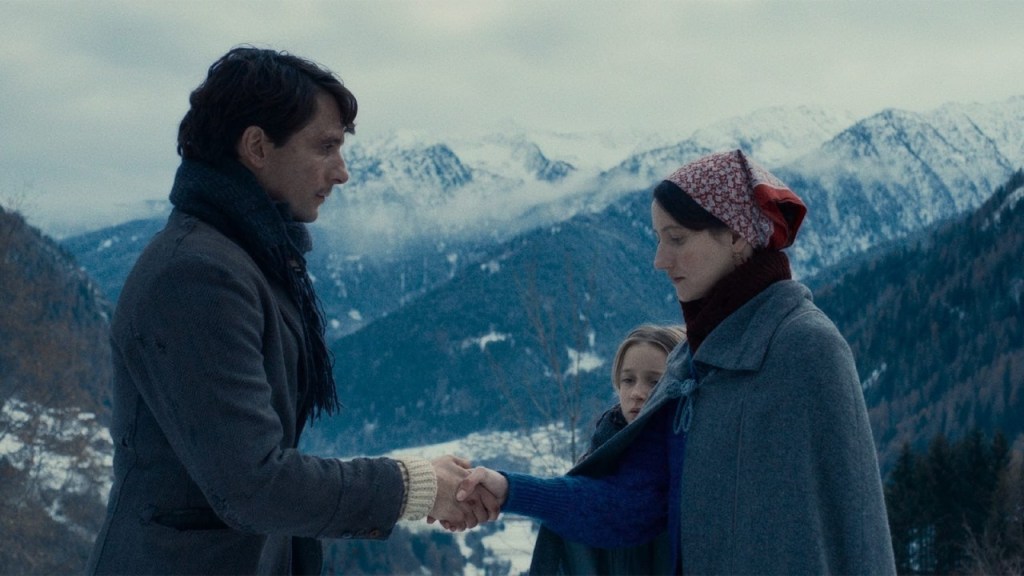
Maura Delpero’s intimate drama starts chilly, then warms as it goes.
In the dead of winter, a large family goes about their daily routines.
They live off their land in Vermiglio, Northern Italy, milking their cows and growing vegetables. It is a peaceful existence in their village, far from the front lines of World War II, yet they have been touched by the death of some of their young men, and the absence of fathers and sons and grandchildren.
The war is ending, and the villagers wait for their missing loved ones to return. Cesare (Tommaso Ragno) rules over his family with exacting expectations for his wife and children. He is also the village’s school teacher, firmly setting the expectations for all the children. Only a few reach the level of excellence that he has set for them to move on to higher education.
The family is very close, by necessity. The children sleep together in a few beds, which draws them even closer together, and breeds a loving intimacy that embraces them, nourishes them. Their intimacy makes them sensitive to each other’s emotions and moods; they tease, though they never fight.
One day, family relative Attilio (Santiago Fondevila) returns home from the war, along with his friend and fellow soldier Pietro (Giuseppe De Domenico), a deserter who hails from Sicily. Pietro is a handsome, moody sort of fellow, and he immediately catches the eye of eldest daughter Lucia (Martina Scrinzi).

His presence stirs some debate in the village: should we welcome a deserter? That passes quickly, though, since the village was not a strong supporter of the war in the first place. And it ends soon enough, so any disputes fall away, leaving a clear path for Lucia to fall in love with Pietro.
Director Maura Delpero wrote the original screenplay, inspired by true stories told to her by her family, and the film relates them with a gentle authenticity that doesn’t shy away from the rigid patriarchal attitudes that held sway in the mid-1940s. Cesare rules his family, mostly with love, yet also with the expectation that they will do what he says and his rule is not to be questioned.
The cultural bias of the villagers comes to the fore after Pietro makes a fateful trip home to Sicily to see his mother, leaving behind a pregnant Lucia. What happens after that is handled with the same deliberate pace that the film establishes in its opening shots.
Captured beautifully by cinematographer Mikhail Krichman, the blues and grays and shadows and soft lights sometimes made the landscapes look stark. Then the camera moves, revealing that the villagers are rarely alone, even if they are sometimes isolated.
Starting with chilly scenes of winter, the film gradually warms up as spring arrives. In like manner, the characters initially appear remote in their emotional makeup. As the narrative moves forward, the depth of their personalities are revealed, and the film becomes quite touching.
Vermiglio is a good film that arrives at the right time of year for quiet reflection upon the past and hopeful anticipation for what future days may bring.
The film begins streaming on the Criterion Channel, tonight (May 20) at 7:00 pm CST. For more information, visit the official site.
 Dallas Film Now.