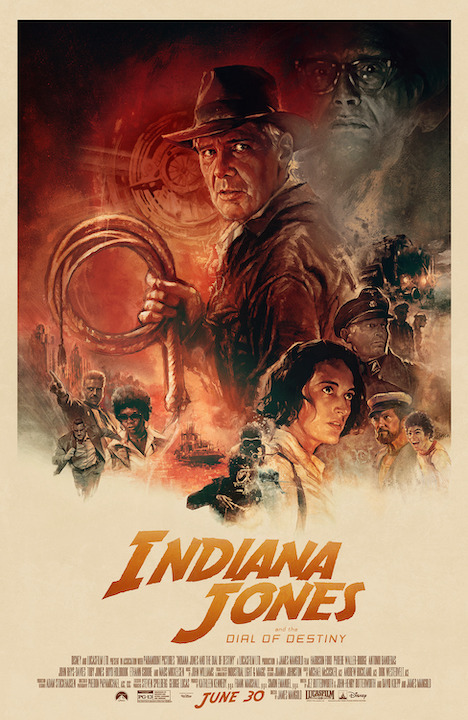
Harrison Ford, Phoebe Waller-Bridge and Mads Mikkelsen star; James Mangold directed.
Good, dumb fun is rarely as entertaining or as outlandish as it could be.
Director James Mangold, accepting the reins from Steven Spielberg, summons his best faux-Spielberg moves, simultaneously paying loving tribute to the filmmaker, mixed with his own Academy Award-nominated (Ford v Ferrari, Logan) dramatic sensibilities and action imperatives, as first expressed in his Western remake 3:10 to Yuma and the comic spy adventure Knight and Day.
Both The Wolverine (2013) and Logan (2017) allowed him to flesh out well-known comic book characters, framing them within dramatic narratives that furthered their characterizations. With Indiana Jones and the Dial of Destiny, Mangold is credited as a writer, along with Jez Butterworth and John-Henry Butterworth, his collaborators on Ford v Ferrari, as well as David Koepp, longtime Spielberg collaborator, who reportedly wrote an earlier draft when Spielberg still planned to direct.
Thus, there is an element of klunkiness to the finished product, yet Mangold makes it all fit together. And it was reportedly his decision/desire to flesh out the opening sequence to its current 25-minute length, which, frankly, starts the film off on very uneven footing, with its extensive reliance on distracting de-aging effects to fit the actors clumsily into the time period (the closing days of World War II). Even setting most of the action in that sequence at night does not help.
Once the film proper begins, however, in 1969, as the old and grumpy Indiana Jones wakes up in a cluttered apartment on the day of his retirement as a college professor, we’re on more confident footing. By acknowledging and frequently referencing the archeology professor’s age, and positioning him as a man who is fully aware of life’s regrets and what he has lost over the years, the story feels more relevant to some kind of reality.
That reality, of course, is only a background for another series of adventures that range from the ludicrous — Indy’s early horse gallop that takes him through a NYC subway — to the ridiculous. I haven’t watched the first four films in quite a while, though I’m sure they are equally filled with sequences that beggar belief.
The increased availability and relatively increased quality of visual effects may have encouraged Mangold and his collaborators to think bigger and more incredible, so we get multiple sequences that push well past credible breaking points, but that’s all part of the fun.
Deep in our bones, we know that no human being could possibly survive all that Indiana Jones has experienced. What makes it fun is Harrison Ford. He makes us believe that Indiana Jones has, in fact, survived all these adventures, and that he yearns for more.
The script also allows Indiana Jones to reflect and ruminate on his life in a manner that’s entirely befitting the character. We understand intuitively that Harrison Ford, now 80 years of age, could not possibly have performed 90% of the action in the movie, no matter what anyone says. We know that many talented stunt performers worked on the movie, filmed expertly under James Mangold’s direction.
Still, we believe in Indiana Jones as a heroic character. He’s a Saturday-matinee action character from the 1930s, true, but that’s still more heroic than you or me, especially at my age. Phoebe Waller-Bridge performs deftly as Helena Shaw, a young woman with a younger person’s sense of adventure and daring, and she is fully Indiana’s equal, and probably his superior in intellect and smarts. Mads Mikkelsen is an antagonist par excellence, happy to be hissable, and unrepentant in his evil goals.
The film goes places I did not expect it to go, on a journey that is thoroughly invigorating.
The film opens Friday, June 30, in Dallas, Fort Worth and surrounding cities, exclusively in movie theaters.

 Dallas Film Now.